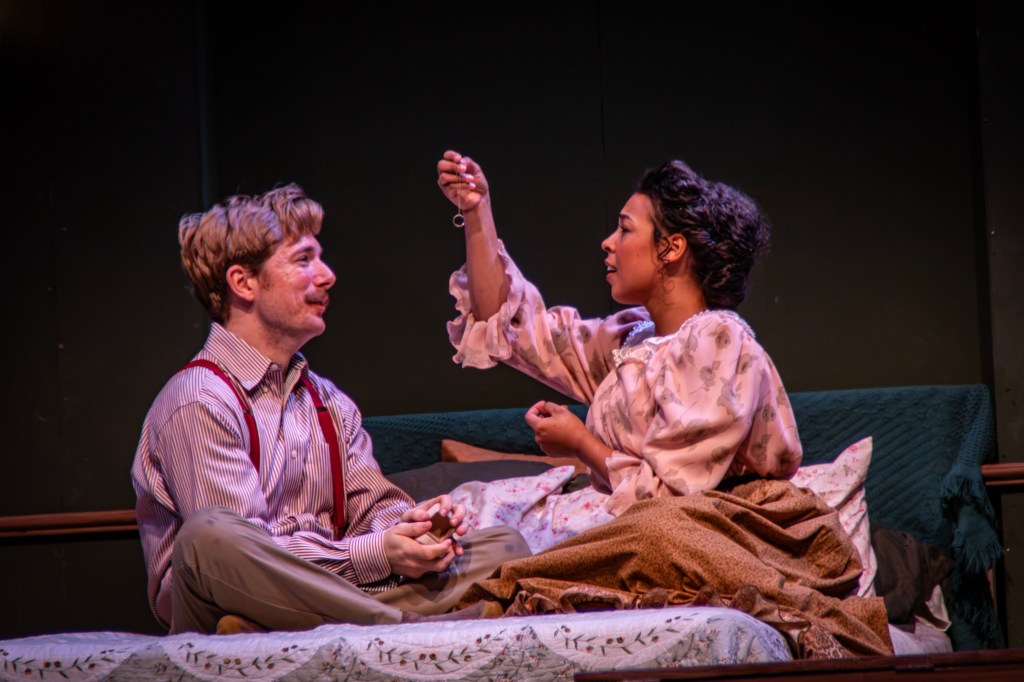
ARC’s “Wedding Band” entertains and educates the audience with performances that pull heartstrings and expand perspectives
This Black History Month, American River College’s production of “Wedding Band” pushes the audience to remember exactly which freedoms had to be bitterly fought for. This tragically beautiful tale of love and hate between a Black seamstress and a white baker grips the viewer with suspense, humor, camaraderie and music.
The play, first presented by the University of Michigan in Ann Arbor in 1966, was written by African American playwright Alice Childress. Set in 1918 South Carolina amidst WWI, the Influenza pandemic, Jim Crow laws, the Chinese Exclusion Act and the Dawes Act, Childress spins a love story between imperfect people who long to love each other without limits. The play closed this past weekend.
Born in 1916 and raised during the Harlem Renaissance, Childress’s writing features characters that feel like they were plucked right out of history and put on stage. These characters come to life under the direction of ARC Theater Department Chair, Sam Williams. Before the show, Williams gave the audience some context about the play, including a content advisory.
“Some of us will be offended tonight. We should be offended by these words.” Williams said. “We’re proud of so much of our history, but we need to take a look at some of our history,”
The show is rated PG due to offensive language, which is further specified by the director’s note. Mentions of lynchings, slurs, offensive children’s nursery rhymes and “Indian war whoops” all ground the play in its era, giving the audience an uncomfortable window into the reality of our country’s history. For two-and-a-half hours, the audience is transported over a century into the past.
The emotional core of the show is Julia and Herman’s decade-long interracial relationship, depicted by lead actors Alexandria Wilson and Christopher Wirth. Wilson and Wirth imbue Julia and Herman’s love with a tenderness and familiarity that conveys long years in just a touch. The ease in which these two characters love each other is hampered by social and legal segregation. Despite ten clearly love-filled years, Julia and Herman cannot be married.
Wilson’s portrayal of Julia in all her complexity is a joy to behold. She is guarded, compassionate, thoughtful and proud. Ten years of holding her tongue about race around Herman comes to a head in a gripping monologue ripe with grief and rage. Wirth as Herman is gentle and charming, but Herman’s unwillingness to examine his privilege as white is a crack in the foundation of their relationship. Wirth expertly toes the line of well-intentioned colorblindness and willful ignorance that is eerily similar to how some white people struggle to examine their privilege in the U.S. today.
“The fact that he’s able to almost turn it off and just be in his own bubble where he doesn’t have to think about [whiteness] in itself is such a privilege that Julia never really gets to have,” said Wilson in an interview with the Current. “She feels like he’s denying her experience, that he’s defending the whiteness without having to actually say that.”
Alongside Julia and Herman are an incredible cast of characters that fill out Childress’s world with people who feel real and familiar. Julia’s neighbors: Mattie, Fanny Johnson and Lula Green, played by Alicia Huff, Sapphire Golden and Aurora Leonardis, provide support to Julia despite the scandalous nature of her relationship. They may judge her at first, but they take precautions to protect her and her love anyway. Their different financial situations, social standings and outlooks provide tension and humor on stage in a way that feels lived in.
Huff as Mattie fills the theater with her powerful voice as she sings songs like “Wade in the Water,” an African American spiritual song. Music in this show is a part of everyday life, prayer, and comfort for the characters as they work through their issues. Golden as Fanny Johnson has an effortless and humorous charm as Julia’s slightly nosy landlady, cutting the tension by drawing laughs from the audience. Leonardis as Lula Green is an earnest and faithful mother who counts her blessings, including her adopted son, Nelson, played by Zion McGehee-Greene.
The conflicts in “Wedding Band” don’t feel like they’re from the past. The struggles the characters face make it glaringly obvious how deeply institutionalized racism is rooted in American culture. This show entertains and educates on the reality of race relations in 1918, in turn prompting the audience to reflect on how much has changed (or not) since then.
“The central conflicts: racial tension, legal barriers to marriage, economic instability, and the way institutions can invalidate people’s lived realities, are not just historical. The idea that paperwork, policy, or systemic bias can determine whether your family “counts” is still present today in different forms,” said Huff in an email to The Current.
“Wedding Band” is a triumph for the cast and crew of ARC’s theater program. The actors fill and command the stage with their powerful performances, providing an immersive and emotional journey for the audience.


Leave a comment